
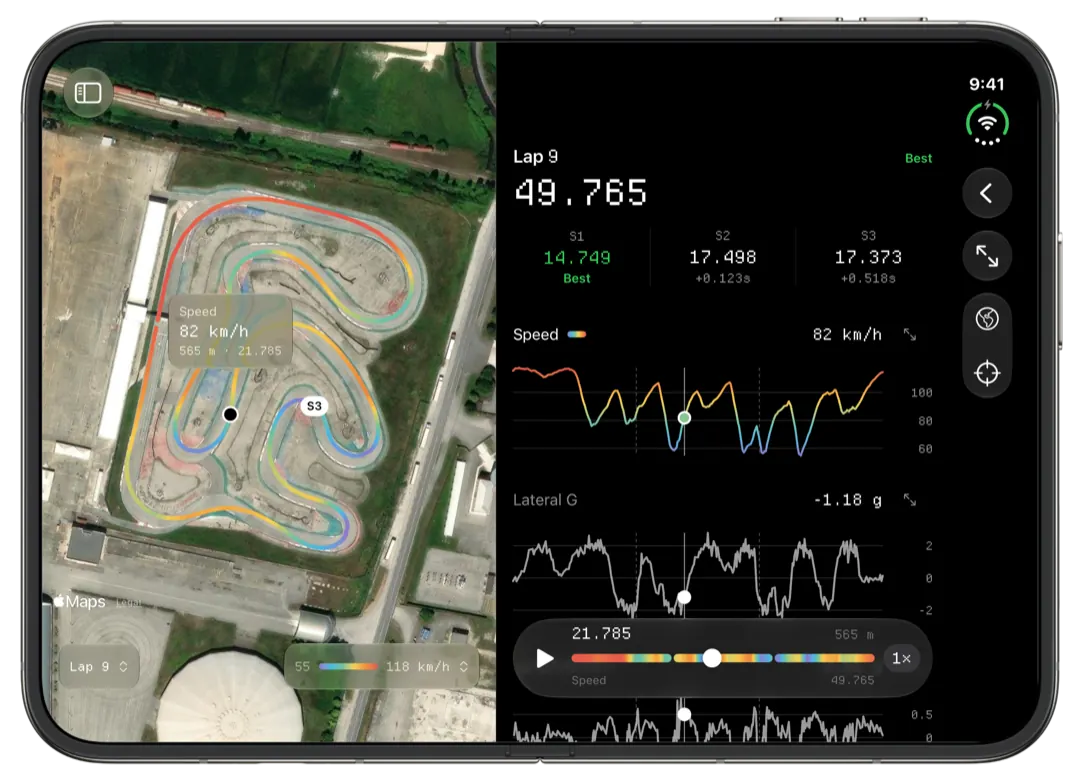
Pick IAME X30 in Slicks and every session from your MyChron or other AiM logger is checked against the window the karting community quotes for the engine: 15,500–16,000 rpm, 580–650 °C exhaust and 50–58 °C water. You see the peaks in plain words, where on the lap they happened, and the carb settings you ran beside them.
The X30 in brief
The X30 is IAME's 125 cc two-stroke: water-cooled, reed-valve inlet, electric starter and a centrifugal dry clutch, with no power valve and a Tillotson HW-27A diaphragm carburettor. IAME's own sheet gives it a rev limit of 16,000 rpm. It is raced in Senior and Junior form, the Junior restricted, in national championships and in IAME's own series.
Two things follow from that for the data. The engine runs right up against a hard limit, so peak RPM is a sharper question than on an engine without one. And the carb has two needles and a pop-off pressure rather than a main jet, so what you write down after each session is a little more involved.
The X30 window, row by row
| Reading | Window Slicks checks | What a peak outside it usually points to |
|---|---|---|
| Peak RPM | 15,500–16,000 | Under 15,500: gearing too tall. At 16,000: on the limiter |
| Exhaust (EGT) | 580–650 °C | Over 650: lean. Under 580: rich |
| Water | 50–58 °C | Too much or too little radiator covered |
These are the ranges commonly quoted for the X30 Senior, not IAME specifications, and your tuner's numbers win. Slicks has no custom windows, so if your tuner's range is different, read the number against theirs.
Why the window stops at the limiter
The top of the RPM window is the limiter itself. A peak that reads 16,000 does not mean the gearing is perfect; it means the engine reached the limiter somewhere, and on the limiter the kart stops accelerating.
To find out how long it sat there, open the fastest lap and read its RPM chart along the longest straight. A trace that rises to 16,000 just as you brake is gearing doing its job. A trace that flattens at 16,000 for the last stretch of the straight is time given away, and the cure is usually a tooth off the rear sprocket.
Then check the laps in the draft. In a heat, a lap tucked behind another kart reaches the limiter sooner than a lap on your own. Pick the two and compare them: both RPM traces on one distance axis, with the gap between the laps drawn along the lap. If only the drafted laps touch the limiter, decide which straight you will race on before you change anything. The method for choosing the sprocket is on our page about kart gearing data.
Exhaust temperature and the HW-27A
The exhaust peak against 580–650 °C is the first check, but the shape along the straight tells an X30 tuner more. Colour the map by EGT, then open the lap and scrub along its EGT chart with RPM and speed above it, so you can see where on the lap the temperature climbs and where it peaks. What that shape should look like on your engine is your engine builder's call; bring them the chart rather than a single number.
The needles are the controls. As a rule of thumb, the high-speed needle has the most effect at the top of the rev range, where the exhaust peak is, and the low-speed needle more off the slow corners. Write both, in turns out, and the pop-off into the carb field when Slicks asks what changed. Put the air temperature in the session's notes, because Slicks does not record the weather and the settings follow it.
More on reading both temperature traces is on the page about EGT and water temperature.
After a heat
| You see | It may mean | Worth talking to your tuner about |
|---|---|---|
| RPM flat at 16,000 down the straight | Geared short | A tooth off the rear |
| Peak RPM around 15,200 | Geared tall | A tooth on the rear |
| EGT peak over 650 °C | Lean | Richening the high-speed needle |
| Water peak over 58 °C | Too much radiator covered | Less tape |
Change one of those at a time, then look at the lap: the theoretical best against the best lap, and the first corner on the Time Loss page. On an iPad or Mac, the lap screen charts every reading against one distance axis, with the map and the cursor moving together, and playback at up to four times real speed.
What Slicks does not do for an X30: it has no separate preset for the Junior, no custom windows, no needle calculator or weather input, and no engine-hours counter for rebuilds.
