
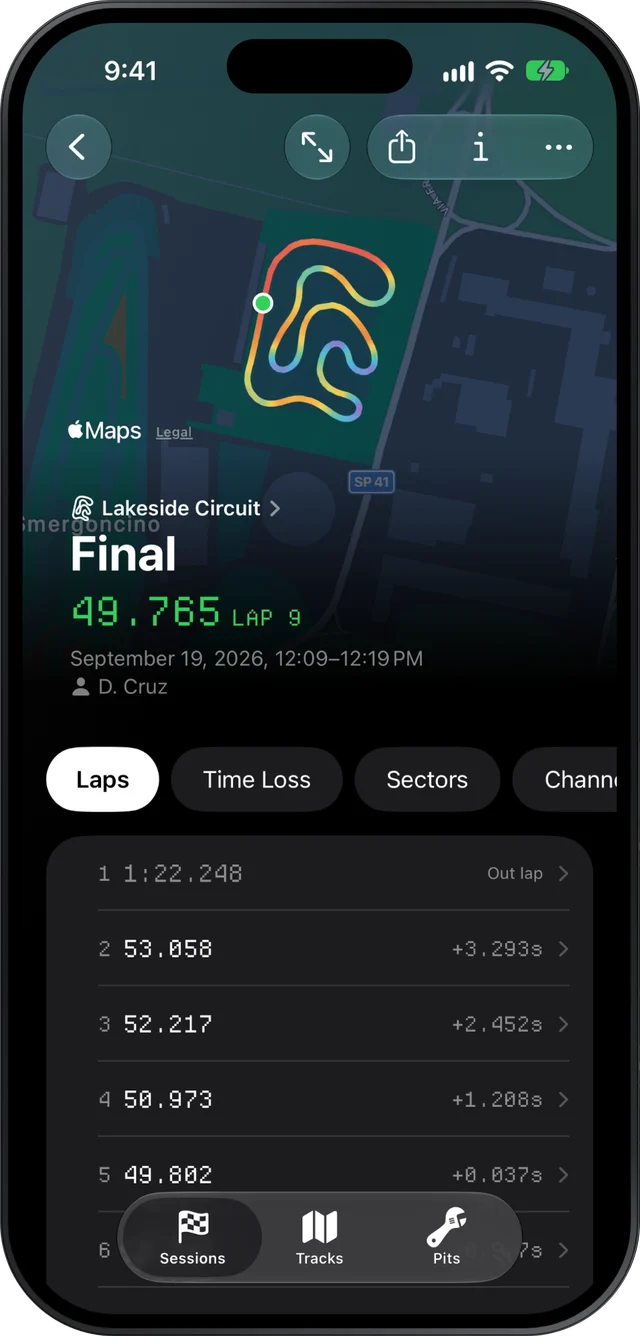
Slicks reads a Rotax Senior MAX session from your MyChron or other AiM logger and checks the engine's peaks against the window the karting community quotes for it: 13,500–14,500 rpm, 550–650 °C exhaust and 55–60 °C water. Rotax Senior is the default preset, so a fresh install is already set up for you.
The Senior MAX and how it is raced
The Rotax 125 MAX evo is a 125 cc two-stroke, water-cooled, with reed-valve induction, an electronically timed exhaust valve, a water pump built into the engine, an electric starter and a Dell'Orto VHSB 34 carburettor. The same family covers Micro MAX, Mini MAX, Junior MAX, Senior MAX, the Masters classes and DD2, the two-speed gearbox version, and it is raced worldwide in the Rotax MAX Challenge and its national series.
The engine is tightly controlled in most Rotax racing, so a Senior team has few engine settings to play with on the day: the main jet, the gearing and how much radiator is covered. Those three show up directly in the three readings Slicks checks, and the rest of the gap to the front is in the chassis and the driving.
The window Slicks checks a Rotax against
| Reading | Window | Below it, usually | Above it, usually |
|---|---|---|---|
| Peak RPM | 13,500–14,500 | Gearing too tall for the track | Gearing too short, or a lap in the draft |
| Exhaust (EGT) | 550–650 °C | Running rich | Running lean; a bigger main jet richens it |
| Water | 55–60 °C | Too much radiator open | Too much radiator covered |
These are the ranges commonly quoted for the Senior, not figures from Rotax, and your tuner's own numbers win. The Setup page says where each peak sat in plain words as well as in colour. Readings in °F are a setting in Pits.
The water window is the narrowest of any preset Slicks has: five degrees. A morning session and a hot afternoon one can land either side of it on the same tape, so it is the reading most likely to change from one session to the next.
If you race Junior, Mini, Micro or DD2, there is no preset for your engine. The analysis all works the same, but the Senior window will not fit your engine, so read the peaks against your tuner's figures.
What to check when you come in
A Rotax routine that fits between practice sessions, in the order the fixes take time:
- Water peak. The narrow window means this is the one to look at first. Adjust the tape before anything else, since it takes a session to know whether it worked.
- Exhaust peak, and where. Colour the track map by EGT and hold it at the hottest point. A peak at the end of the longest straight is where you would expect it. If the air has warmed or cooled since the morning, the main jet may need to follow; our page on EGT and water temperature covers reading the trace.
- Peak RPM, and where. Same method: colour the map by RPM and check the peak is at the end of the straight, not a spike from a kerb. Choosing the sprocket from it is on the page about kart gearing data.
- Then the lap. The theoretical best against your best lap, and the first corner on the Time Loss page. Tap it to open Compare with the lap that lost the most there.
Write down what you change at the next import, when Slicks asks what changed on the kart: gearing in front and rear teeth, the carb setting, pressures, tires. That is how the exhaust peak and the jet that produced it end up on the same page.
Over a Rotax race weekend
A Rotax MAX Challenge weekend is a run of short sessions: practice, then qualifying, heats and the final, each one a file. Mark each session's type when you import it, and the weekend reads in order afterwards. On the Mac, the sidebar groups sessions into race weekends, and the Laps tab charts one channel across every lap of a session, so a water temperature still climbing in the final laps of a long final is plain to see.
The Tracks tab keeps every session by circuit, with your personal best there. Next season at the same track, the setup you wrote down and the peaks it produced are where you left them.
What Slicks does not do for a Rotax: it has no preset for Junior, Mini, Micro or DD2, no custom windows, no jetting chart or weather input, and no engine-hours counter for rebuilds. It reads the data your logger recorded and nothing from the engine's own electronics.
