
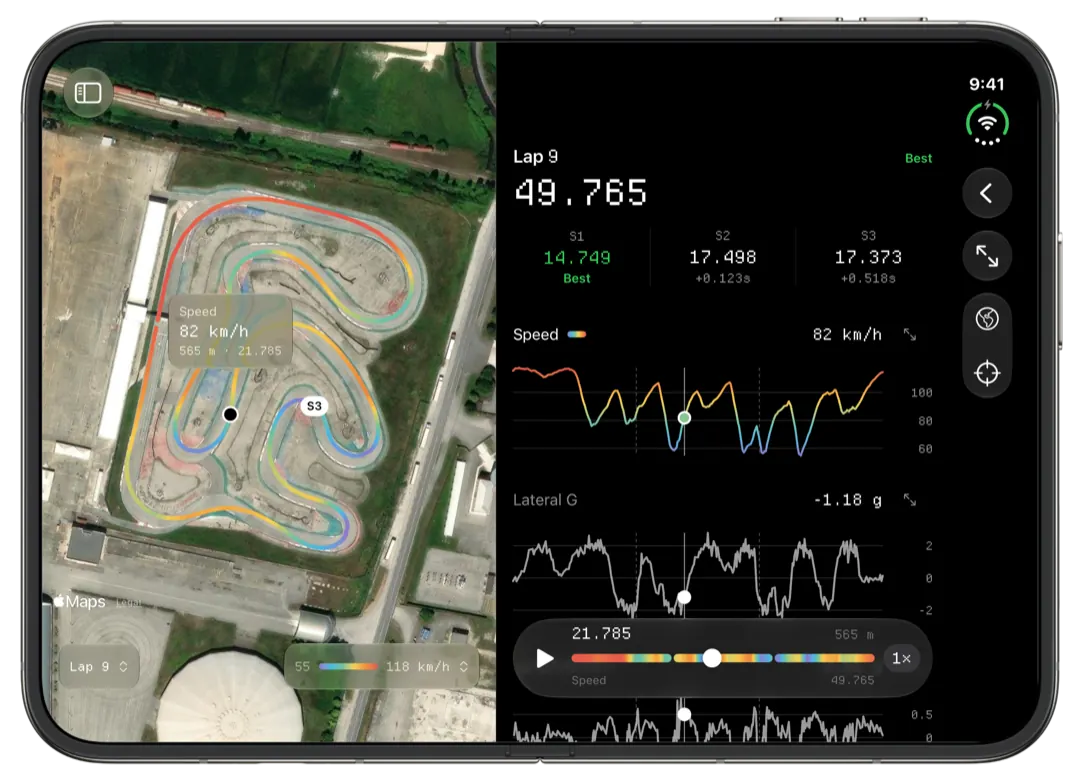
Slicks measures karting consistency for every AiM or MyChron session you open: the standard deviation of your lap times, and how many laps were within half a second of your best. On an iPad or Mac it also charts each lap's time in order, so you can see whether the session settled down, stayed steady or fell apart.
The two numbers, and what each one tells you
Open the Laps page and under the list of laps you'll find a line like this:
Consistency ±0.31 s · 7 of 12 laps within half a second of the fastest.
The ± figure is the standard deviation of your lap times. In plain words, it is how far a typical lap sits from your average lap. The smaller it is, the more alike your laps were.
The count is how many full laps came within half a second of your fastest lap, the fastest included. It answers a simpler question: how often did you get close?
Each number misleads on its own. The standard deviation is sensitive to one bad lap: a single trip off the track can double it, even if every other lap was within a tenth or two. The count ignores how far off the other laps were. Read them together:
| Spread | Laps within 0.5 s | What it usually means |
|---|---|---|
| Small | Most | A steady session. Time now comes from pace, not repeatability. |
| Large | Most | One or two outliers. Find them in the list; the rest was fine. |
| Large | Few | Genuinely up and down. This is where the easy time is. |
| Small | Few | Steady but well off your best lap. The best lap may have been a one-off, a tow or a fresh tire. |
Which laps count
Slicks uses every full lap except the out lap and any lap the logger cut short. It does not try to guess which laps were in traffic or under a yellow, because it can't know. That keeps the number honest, but it means you have to look at the list yourself: if lap 9 is two seconds off, you know why, and you can mentally set it aside.
A session needs at least three full laps for the numbers to appear.
What good looks like
We won't give you a target number, because one that suits a 40-second club track in the dry means nothing for a long circuit in the wet. Some general guidance instead:
- Compare like with like. Your consistency at one track against your own sessions at the same track, in similar conditions.
- Expect it to change through a weekend. Practice, where you try things, should be less consistent than a final, where you don't.
- Short sessions read high or low by chance. Four laps of qualifying say less than sixteen laps of a final.
- Watch the trend over a season. A spread that falls from one visit to the next is a driver improving, even when the best lap stands still. The personal best tracker keeps every session at a circuit together, which makes that easier to follow.
The lap trend chart on iPad and Mac
On an iPad, and on the Mac, the laps come with a chart of each timed lap's time in order, the fastest in green. The axis hugs your lap times rather than starting at zero, so differences of a tenth or two are easy to see.
Shapes to look for:
- Falling, then flat. You were finding your way, then settled. Normal for a first session.
- Flat, then rising. Tires going off, or you getting tired. A late rise in a long final is worth noting before the next one.
- A sawtooth. Good lap, bad lap, good lap: often traffic, or a corner you only get right every other time.
- One spike. An incident. Ignore it when judging the session.
Consistency and outright pace are different problems
Being consistent and being fast are separate skills, and they need different work.
If your laps are scattered, the fastest way to improve your average is to drive your good lap more often. Your theoretical best shows how much is on offer inside each lap, and the Time Loss page shows which corners cost your other laps the most against your best.
If your laps are tight but slow, more repetition won't help. The time has to come from somewhere new: a different line, a setup change, or watching what a quicker driver does.
What Slicks doesn't do here
Consistency is worked out per session. Slicks doesn't chart it across sessions or weekends for you, and it doesn't let you exclude chosen laps from the calculation. It also measures consistency of whole laps, not of each sector.
